

By David Peterson, Ozark Society Past President

In 2000, when Johnny Morris, owner of Bass Pro, bought Dog Patch, the defunct eyesore along highway 7, in Newton County, there were visions of 600 construction jobs, 170 park employees, $1.4 million in sales tax revenue, and $324 thousand in annual property taxes. Plus, a hotel with comfortable rooms, golf courses, a waterfall of course, trout pond, exotic animals, caverns, and nature trails, and a good restaurant.
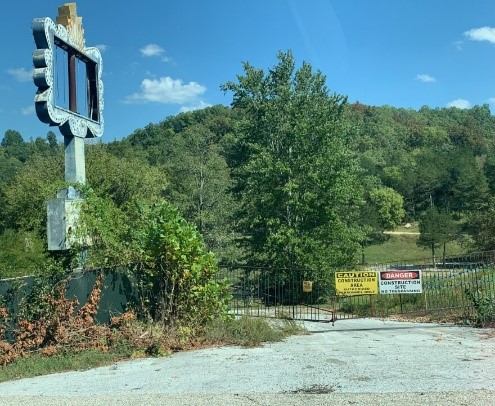
Entrance to Nature Park property today
It hasn’t happened. But recent action suggests maybe the real construction is about to begin – a pipeline to the once problematic Marble Falls wastewater plant and continuing gnawing into a hillside looking for a waterfall. And then an Arkansas Department of Environmental Quality (ADEQ) permit to expand the plant capacity from the current 10,000 gallons per day (G/D), to 15,000 this year, and then in a phase III to 30,000 G/D.
When I called Bass Pro to confirm a completion date, the nice lady said “not imminent, not in my lifetime.” She is 70.
The main problem with Mill Creek water quality is high levels of E. coli which limits water contact for humans in both Mill Creek and the Buffalo River, see right. But algae supporting nutrients nitrate and phosphorus are also a problem. At issue: is the low volume Marble Falls wastewater plant at fault, or is it cattle in the Crooked Creek basin which connects to Mill Creek through Karst, or some other source? A paper by Ozark Society member David Mott, et al in 1991 (sponsored by ADEQ) found that “water quality impacts from Marble Falls wastewater treatment District were insignificant due to minimal flow and low concentrations.” The issue right now. Does the tripling of effluent capacity in anticipation of the Bass Pro project and other related development mean that this conclusion is still valid?
The Ozark Society recommendation:
Since 2009 when the first water contact closure was issued, there have been periodic studies of water quality in Mill Creek, but not sustained enough to constitute a data base which would include nitrate, total nitrogen, total phosphorus, dissolved oxygen, discharge, and of course E. coli. And even worse perhaps, there seems to be no public record of these characteristics emanating from the wastewater plant at the Marble Falls wastewater plant. Increased monitoring with public access to data should be a joint effort from the National Park, the wastewater plant, and ADEQ, starting now.
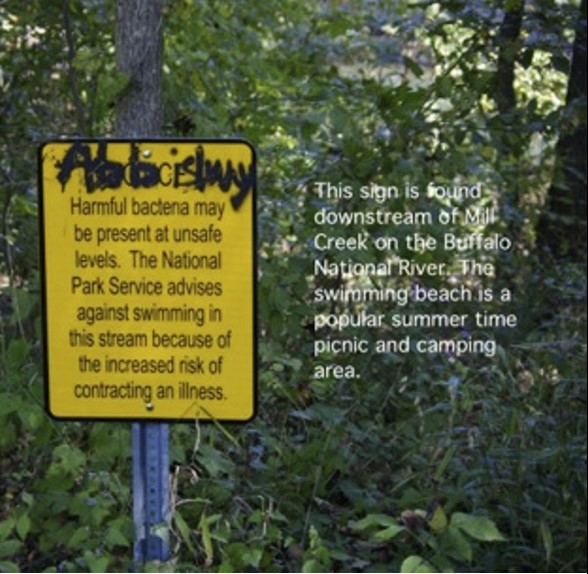
Danger sign for water quality