

By Don House, OS Highlands and Buffalo River Chapter Member
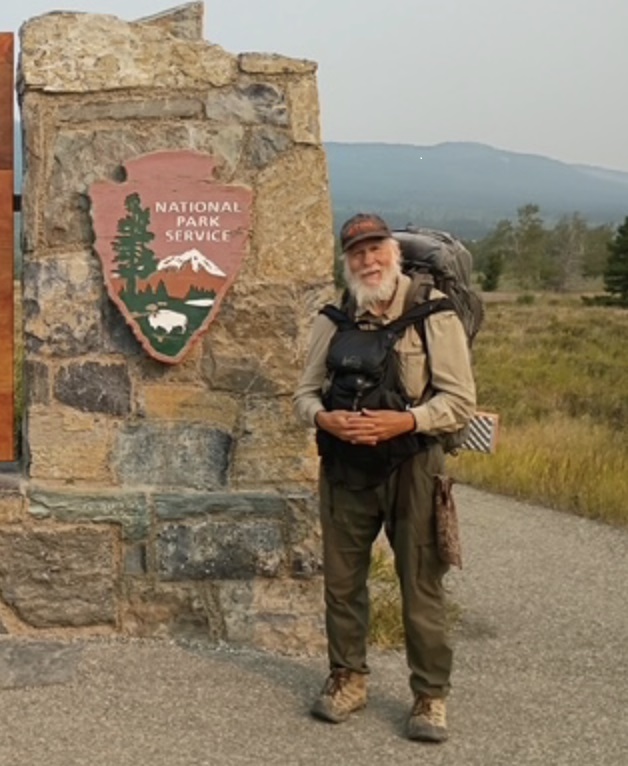
I attended school in the United States, so by definition, I am ignorant of all things geographical. Proof of this hypothesis, is that after my first telephone conversation with Sassafras Hiking Award recipient Kurt Bachmann, I had to resort to maps and atlas to put into perspective what I was hearing. “Last year I hiked the Continental Divide Trail from southern Montana to Mexico, and this year I’m starting in Montana and doing the northern section to the border with Canada.” Those words do not compute in my catalogue of outdoor activities. I consider myself a hiker. I spend considerable time doing just that, but my conversation with Kurt made it clear how circumscribed my range is. And while I measure my distances in single digits, his tend to the hundreds and thousands. He is a hiker of another level, as nonchalant and soft-spoken as he may be about his accomplishments.
We spoke from his room in a hostel in East Glacier Park just off the Continental Divide Trail at the southeast corner of Glacier National Park. The connection was iffy, we both expected it to go out at any moment, but it held. This year he has had to deal with snowstorms and freezing rain (which he considers more dangerous than the frozen-solid version)—and lately with smoke coming over from the devasting fires in Washington, smoke that is blocking the view of the mountains as we speak. The high Montana section of the trail is a rough one, it follows the divide at 8,000 feet elevation or so, there is little water available, and he has to carry more than usual to get through the dry areas. An Ozark hiker might be forgiven for feeling water-flush—it is a rare outing that does not offer a chance to filter and refill canteens along the way if needed. But Kurt makes it clear that the two big questions on any long-distance hike, anywhere, anytime, including sections of the Ouachita Trail, are: where is water, and where are resupply options.
On some trails, like the Appalachian, resupply options are a short hike or hitch from the main trail, but out west, he’s had to hitchhike thirty miles off-trail and back, to the closest town for food and fuel. And in the Ozarks, he has had to send supplies ahead to post offices along the way. He speaks fondly of the Bluebell Cafe’ in Story, Arkansas, about 15 miles northeast of Mt. Ida, and Lori, the mother of the Ouachita trail who cooks for and shuttles exhausted hikers, and receives and stores resupply packages.
Raised in Indiana, he has called Norman, Oklahoma home for the last quarter century, where he taught high school: Physics, Astronomy, and Electronic Circuits, before retiring recently. I was rude enough to ask his age—66, which he considers on the low end of old. He was kind enough not to ask my age, which I would have to define as middle old age perhaps. When I asked the standard question of what brought him to long distance hiking, he laughed and said he became serious after his wife left him, with the first excursion in 2012– the 500-mile Camino de Santiago in Spain, then the 300 mile Long Trail in Vermont. Until his retirement from teaching, he was having to schedule hikes to correlate with summer and Christmas breaks. Now he has more control of his own schedule, and the itinerary has expanded accordingly.
There have been so many long-distance hikes, that when I ask about them, he has to ponder a while. That list includes the trifecta of Pacific Crest, Appalachian, and Continental Divide Trails, the Ouachita Trail six times, the 300-mile Lake Superior trail, Isle Royale trails, the 400-mile St. Olav’s Way in Norway, the Ozark Highlands Trail three times, and the 1,100-mile Florida Trail. “Pardon me,” I said, “did you say 1,100 miles?” “Well,” he said apologetically, “it was pretty flat.” He includes half the Arizona Trail, a hike that was cut short by the appearance of the highly contagious Norovirus, that had hikers using plastic bags as makeshift gloves to touch gates, pump handles, and shelter surfaces, and the roughly 300-mile Ozark Trail in Missouri.
He sometimes stays in hostels—a frugal alternative in some places, especially out west, that helps keep costs down—and also routinely makes use of busses to get to his hiking destinations and back. He knows the routes and the companies well: Greyhound (recently bought out by the German company Flix), Jefferson, and Peter Pan, and the interesting characters he meets become part of the whole experience.
A cross-country trip on a bus is something he thinks that every voter should consider doing, an introduction to real people, perhaps. He ranks states by how good the bus system is, and to my disappointment, considers Arkansas a bus-unfriendly state. He doesn’t like to fly, he finds the restrictions and rules onerous, rules that had TSA confiscating his camp stove on one flight—enough to change a person’s attitude about flying. Buses are more humane, more understanding, more logical in these matters.
When it comes to advice for folks who might be thinking of the long-distance experience, he recommends the FarOut maps because of their consideration of critical water and resupply information, and real-time feedback from hikers. He carries 4 small portable battery chargers to keep his phone up and running, and recharges them all at the next hostel. He considers himself the polar opposite of an ultra-light packer, more of an ultra-heavy one, he says. He likes to have enough clothing and equipment to handle the nasty surprises and emergencies that can develop in rough, isolated situations, where help may be at a considerable distance and time. “It can be dangerous out here,” he says, “last week six hikers died of falls, exposure, and lightning (a form of exposure). “Falls,” he says with emphasis, are the greatest danger.” And he had his own reminder this past April when he slipped off a rain-soaked trail near Blanchard Springs, slid down a steep incline and into the creek, luckily uninjured except for the destruction of his phone. I am reminded of the rule of threes from wilderness first aid courses, a way to remember what is most likely to kill you, what you need to consider first: 3 hours exposure, 3 days water, 3 weeks food. You dismiss exposure at your peril. Perhaps one of the most important aspects of being an experienced long-distance hiker like Kurt, is knowing when to stop and turn around, when not to go.
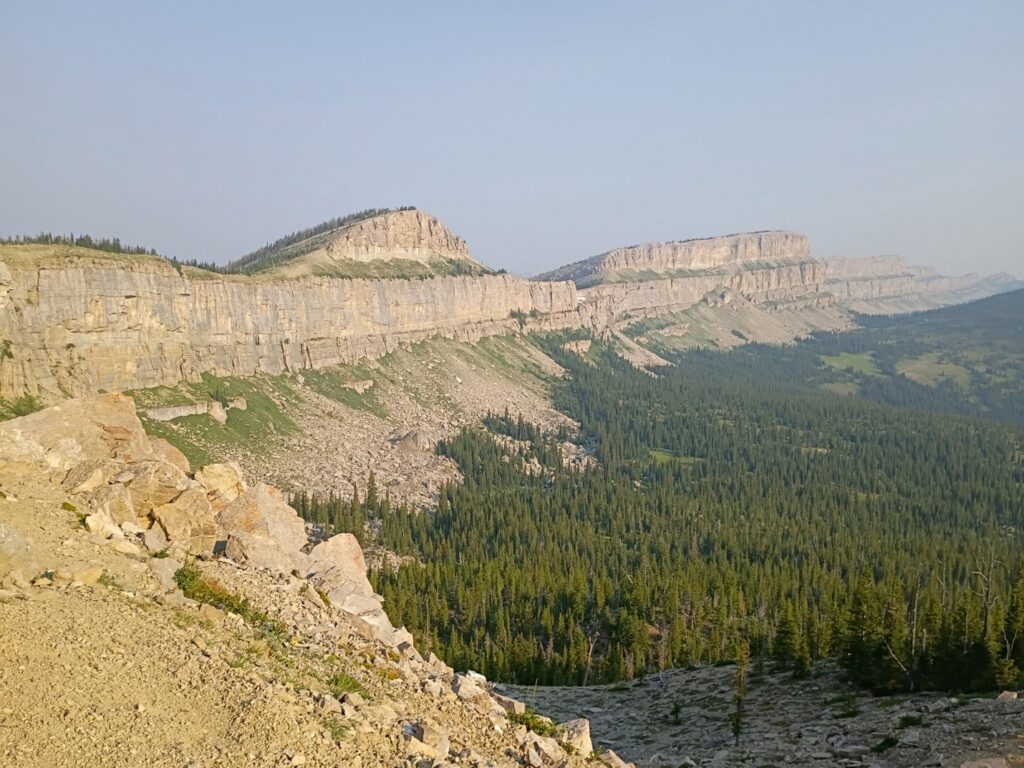
He hikes alone. He says that on a trail like the Appalachian, he is never really alone, but on some western trails, he can go days without seeing another human being. He is a loner by nature, and slower by choice. He meets a lot of hikers that are fast and athletic oriented, doing the trail, conquering the trail, setting records for time and distance. “I guess they don’t actually see anything,” he says. “I am not an athletic hiker. I am a scenic hiker.” He describes wildflowers, bear, deer, big horn sheep, goats, and squeakers that he defines as all the unseen and unidentified, but loud birds and rodents that add to the hiking soundscape. He takes photographs and posts them on Facebook, including this image of the Chinese Wall geologic phenomenon in the Bob Marshall Wilderness Area in Montana:
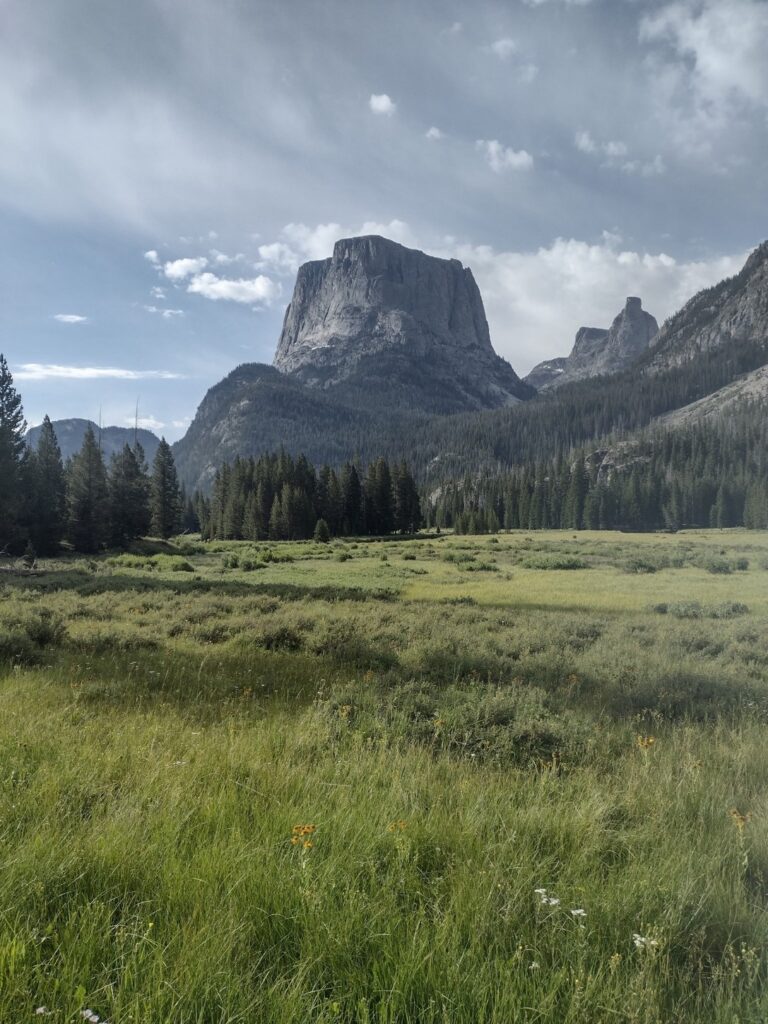
And this image of Squaretop from last year’s hike on the Continental Divide Trail in the Wind River Range in Wyoming:
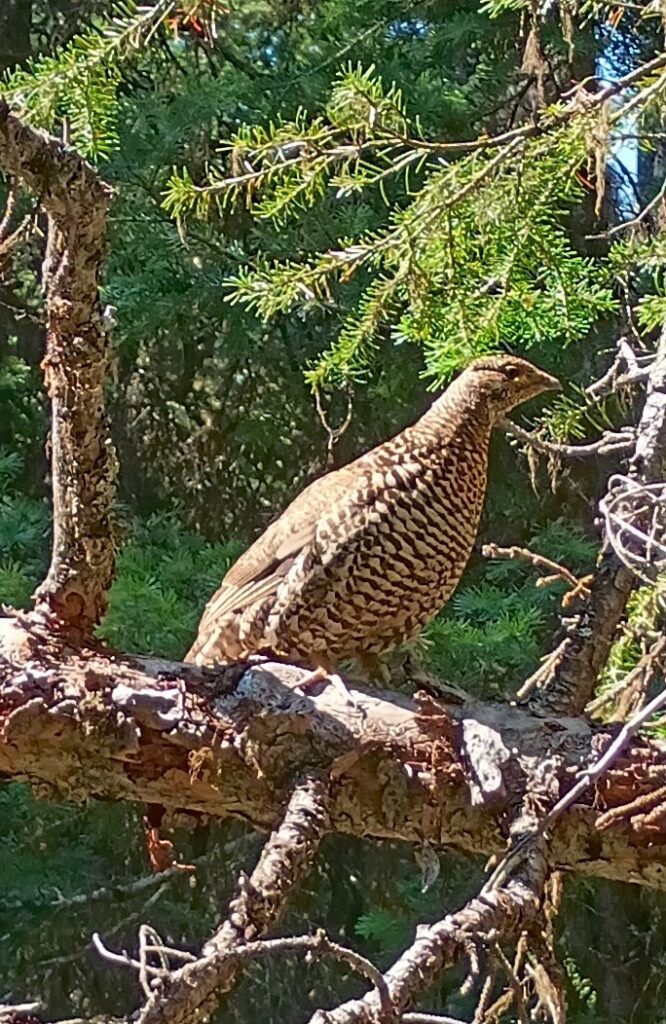
And this photograph of a Grouse, a species he finds in several mountain ecosystems, east and west:
Kurt tells me that his first long-distance hike choice had been inspired by the 2011 film The Way, a comedy/drama starring Martin Sheen, that follows a man whose estranged son has died while hiking the El Camino, and who, in response, decides to walk it as a tribute, and distribute his son’s ashes. A story of love and loss, a closure and a starting over, a changing of the path one’s life is following. It feels too intrusive to ask Kurt directly the begged question of whether his first trek was undertaken for therapeutic reasons, perhaps the end of a marriage, and whether it was successful in that regard. I draw my own conclusions from the rest of the conversation, and when we hang up, I reach for my laptop and issue a friend request. I want to keep track of this man.