

By Fred Paillet, Ozark Society Education Chair
This one new reference arrived with no warning to address my concern about global warming, conflated with both my most treasured outdoor experiences and my most intense ongoing professional interests. That’s quite a bit to ask from a young author’s first major publication. The book is North to the Future – an Offline Adventure Through the Changing Wilds of Alaska by Ben Weissenbach. The introduction got my immediate attention since it squarely addressed the topic of Polar Amplification. As readers must know from my previous work, I anticipate disproportionate distribution of global warming (temperature change amplification at the poles) to have a major effect on weather patterns from the way it decreases the latitudinal thermal gradient. This is going to affect (or perhaps is already affecting) the fundamental nature of the storms and droughts we experience. In this book, a young Princeton graduate decides to travel north to experience the changing climate there while consulting three notable experts investigating three important aspects of climate model verification. These are: permafrost degradation, high latitude glacier dynamics, and northern tree-line expansion. That alone would be of real interest. But the author’s experience includes strenuous backpacking and rafting excursions down the wilderness routes I have taken and surveys of a remote Brooks Range glacier that I personally explored over two decades ago. Being able to recall the effort of bushwhacking through tangled alder thickets and downed timber, climbing steep unstable slopes, tottering with heavy backpack over treacherous tussocks, and navigating unstable pack rafts through wild headwater streams added an extra dimension to the reading experience.
As a scientist I could identify with the technical task during each of these journeys but was distracted by the author’s repeated angst about his book-learning experience making him ill-prepared for the many practical challenges of each expedition. Then there is the lengthy exploration of the exotic backgrounds of these three scientists (Kenji, Matt, and Roman) who established rogue status for their unusual careers. I also had to cringe at the inadequate explanation of background details related to how the data collection addressed the physical processes being investigated. A good part of the book describes two long Brooks Range backpacks with Roman and graduate assistants that involved patrolling the northern edge of spruce distribution to count tree seedlings. Simply counting seedlings is not a very good way to assess tree line advance which depends on a sequence of seed dissemination, seedling gemination, and longer-term survival against climatic events. Timber lines on Rocky Mountain slopes are characterized by low krummholz thickets of trees that cannot thrive enough to produce seeds or experience temperatures too low to allow seeds to germinate. Such trees propagate by “layering” where branches pinned to the ground by snow generate roots and produce new stems to be beaten back by winter storms. This situation is usually interpreted as produced by climate deterioration where temperatures are decreasing and trees are forced to retreat downward, leaving non-reproducing and stunted versions behind.
Ecologists have observed that the northern tree limit in Alaska is very different. Instead of having a border of krummholz, Brooks Range tree line has a scattering of trees of all sizes that progressively thins with distance from the closed forest. That leads many to believe that it is the difficulty of getting spruce seeds to gain a foothold that limits the process. Once the seeds find a substrate that is hospitable in terms of competition and microclimate, they can grow to maturity. This important background context is ignored in the excitement of simply discovering seedlings. It would also have helped to have a precise description of the “seedlings” to understand how they are related to the specific environment that has allowed them to gain a foothold, and how likely they are to survive winter blasts when they grow above the protection of snow cover.
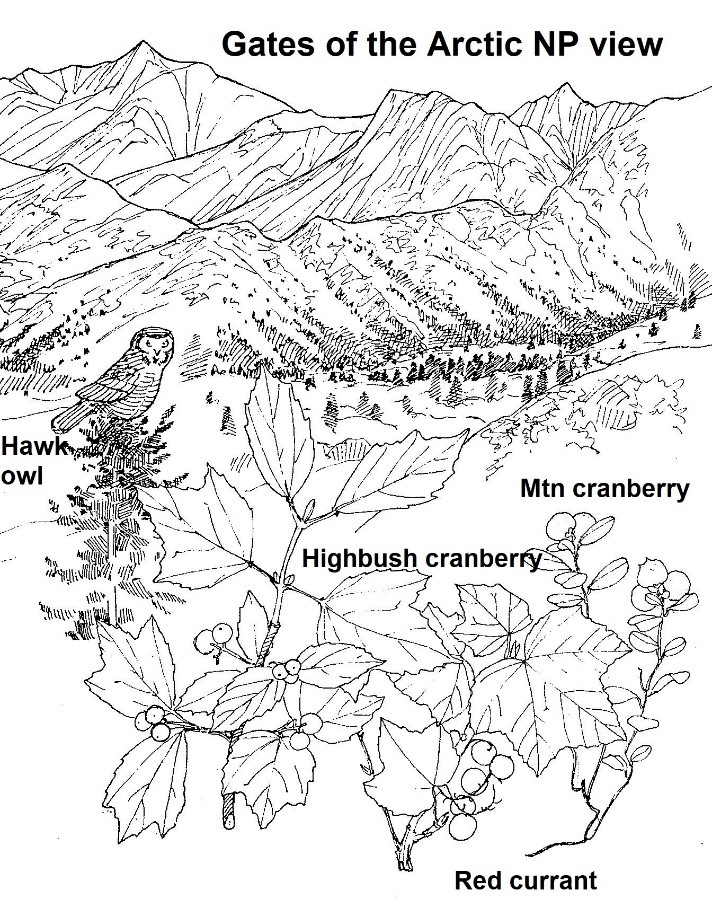
For me, that frustration at the lack of technical detail was more than offset by description of the wild places of my personal outdoor adventures in the far north. These include verbal images of Igipak Peak in Gates of the Arctic NP and the Romanzoff Range in the ANWR. Along with bushwhacking and/or floating in the Ipnelivik, Ulaneak, Ambler, Kelly and Wulik drainages. This brings memories of fighting through soaking alder thickets and over jumbled piles of splintered avalanche debris to shiver by a sodden campsite on the Ulaneak. Then waking up in the morning to see moose tracks showing how the beast had tipped over a tent peg while we slept in exhaustion. I can look at my old photos of Igipak’s distinctive fishtail summit (meaning of the name in Inuit) taken after climbing an adjacent peak to experience its skullcap-like glacier. I can recall the mutual surprise of all parties involved when floating the Ambler and encountering a swimming bear straight ahead. There were savory meals of entire arctic char each big enough to feed five baked in willow-wood coals on the banks of the Wulik. Recalling those experiences made the book for me despite the frustrating lack of real technical detail.
Of course, that is not the author’s point. The punch line comes through loud and clear: the mechanisms that will act to change climate as the greenhouse gas content of our atmosphere increases are a lot more complicated (with largely unconstrained global model coefficients) than is perceived. For example, Kenji explains to the author that permafrost does not melt like a block of ice in the sun. This means that the assumed addition of frozen stored carbon in the soil adds to the carbon content of the atmosphere in a way that varies greatly from place to place. The devil is in the details and the details are complicated. The same for melting glaciers, which depend on the total mass balance of the ice field. As a warming climate increases the vapor carrying capacity of the atmosphere, it can cause an increase in ice accumulation that can offset ice loss at the glacier terminus. We expect Antarctica to melt more around the edges, but the moisture flux of the warming atmosphere will likely increase ice thickness in the interior. In the case of Matt’s investigation of the McCall Glacier, he thinks warming may retard ice loss as the insulation provided by the accumulation zone thickness decreases. And that is for only this one particular glacier. The author contrasts his own book learning based on definitive models with the practical issues of generating the coefficients needed to make those models function. These data must be laboriously collected in enough quantity to be effectively integrated into a meaningful representation of those critical driving coefficients. Many readers will not be informed enough to care about the details of the measurements but should appreciate how difficult the provision of these model coefficients is in the model-based prediction process. In the past I have emphasized things from the top down: Polar Amplification will change the way the weather systems operate. Here the author presents the uncertainty from the bottom up via the nuts and bolts of parameter estimation. Both approaches serve to emphasize the way that humanity is taking our climate into the great unknown – where there may be no turning back at all.