

By Fred Paillet, OS Education Chair
The Ozark chinquapin, a member of the chestnut (Castanea) family, is a sometimes-forgotten feature of our local folklore. I have been personally interested in the tree through my New England botanical background in the study of the American chestnut. The loss of that tree after 1904 to an introduced fungal disease was a huge economic loss in terms of timber for construction, bark tannins for the leather industry and abundant nuts for human and livestock consumption. The Ozarks had its own local variety of chestnut in the form of a chinquapin that has long been of questionable classification. It was often confused with a shrubby version (Allegheny chinquapin) growing throughout the southeast. Field work by my students and other researchers now has DNA analyses and other data to show that the tree is indeed its own distinct species. But questions have remained about whether this was a real forest tree of substantial size or something of less stature than the oaks, hickories and pines with which it was associated.
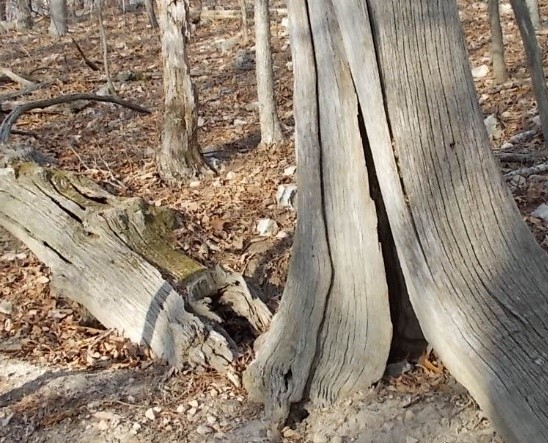
My work with local graduate students addressed the stature issue by surveying the fallen remains of local chinquapin trees we showed were killed by the chestnut blight fungus in 1957. That was easy to do because the wood is so rot resistant that relatively intact chinquapin logs could be found more than fifty years after they were killed. A definite date for that event was derived by taking tree ring cores from nearby trees to identify the year when those adjacent trees suddenly accelerated growth after chinquapin competition was removed. Our work showed that Ozark chinquapins were growing as canopy trees when blight felled them. But examination of the fallen logs showed an unusual twisted and contorted shape to their trunks. That posed a challenge for me as an amateur artist. Would it be possible to find chinquapin logs in old growth forest representing former mature canopy trees, and would there be some with enough of the branches in the deteriorating crown intact to reconstruct the trees’ shape?
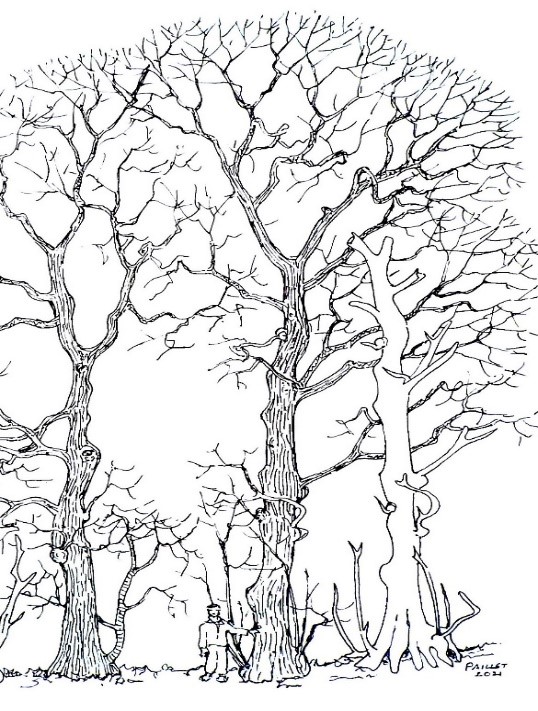
Because my survey work in mapping Ozark chinquapin made me familiar with the general distribution of the original blight kill in relation to various forest conditions, I decided to focus on forest plots with no obvious signs of past disturbance history and now dominated by oaks and hickories appearing more than a century in age. The most likely candidate was a narrow upland ridge in the Wedington block of the Ozark National Forest in Washington County. There were a pair of large old chinquapin trunks lying on the ground beneath mature post oaks and mockernut hickories with about 45 feet of their central trunk intact surrounded by old-growth trees that were about 65 feet in height – typical for mature forest on narrow, well-drained ridges. Both logs had a single trunk such as we found for the vast majority of old blight kill in the most undisturbed areas investigated earlier. Enough of the branches radiating off the central trunk remained to provide an idea of how they once spread out to form the tree’s crown. The only remaining question was the nature of the fine branches that would have been at the very top. I first tried using the crown structure of the largest chinquapin sprouts that still survive as understory trees, but figured their form was not typical of mature trees. They were either severely stunted by competition, or in the process of rapid upward growth after release by disturbance – only to be killed back by another blight attack once again. The best old-growth chinquapin image available was a photo I made of what could be a last survivor of the original attack shown to me by a USFS biologist in 1990. Even if not a true remnant, this tree escaped blight long enough to have a fully rounded, canopy-emergent crown similar to that of adjacent oaks.
After carefully measuring the diameter and width of every section of the two old chinquapin logs, I began my illustration by showing the two logs as if still standing upright. Using that guideline, I then sketched in the fully bark-covered trunks, then the main branches extending up to the approximately 65-foot height of the surrounding canopy. One of those two examples is shown in my illustration here using my 5-foot-ten self as a handy height scale. You see the planform of the log as measured next to my reconstruction of the tree when it was still alive.
Two unusual features stand out in this depiction. First, the series of shifts in the line of the tree’s trunk. Foresters call these bayonet joints from their resemblance to the offset where bayonets are attached to the barrel of a rigidly straight rifle. My explanation is that this strange growth form results from the ability of our chinquapin to put on rapid growth that lasts late into the growing season whenever conditions such as death of an overstory tree prevail. The tree is equipped to take maximum advantage of good times when they occur. Since we live in the interior of a vast continent, our climate is decidedly continental. That means that sudden early frosts can occur to damage the terminal growth leaders of these precocious little trees. The loss of the topmost growth center of the growing trunk causes the tree to resume growth the following spring by means of what was originally intended to be a lateral branch bud. A shoot from this new growth center must bend around to point upward – hence the observed shift in the axis of the trunk.
The other unusual feature seen here and on the majority of former large chinquapin trees that we examined showed small and stunted little stems attached to the base of the large tree. I describe them as natural bonsai trees because they appear as slow-growing dwarf trees perched on the basal bulge of the main trunk. Lots of other forest trees have a habit of sprouting from the base in response to injury to the main stem, but these little basal twigs seem to always be there with or without an obvious injury to the “parent” tree. It is hard to see what kind of ecological advantage this kind of basal sprouting would have. Perhaps it is just an incidental residual in a species that was once growing as a shrub before it evolved into a forest tree. Sort of like the residual organ called an appendix that we have which seems to be of no real positive use and may be a relic of a very different ancestral digestive process.
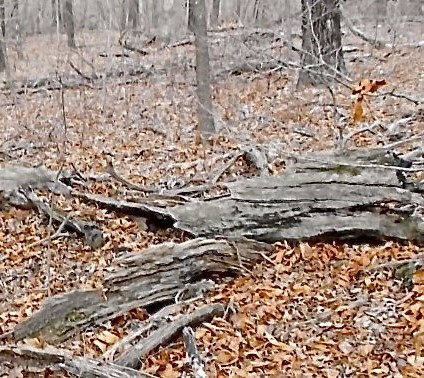
Now that you have seen my reconstruction of Ozark chinquapin in all of its old-growth forest splendor, where might you go to see remains of old growth chinquapin for yourself? Most of the locations where such big trees can be found are off the beaten path or otherwise hard to pinpoint on the map. But there is one easily accessed location you can get to on the Bella Vista Back Forty trail. You can find this location by traveling several miles east on AR route 340 (E Lancashire Blvd) from where that route crosses US71. Go past Bethnal Road on the right and into a curve turning to the north (left). You will see a large water tower looming on your right. Coming out of this curve, stop where you can pull off to the right onto a relatively flat grassy area about 100 yards before reaching a posted trail crossing (coordinates: lat. 36.494, long 94.184). Go across the road and find the trail where it comes back towards you on the roadside opposite your parking spot and then winds down into the head of a steep little ravine. Wind around a hundred yards or so (a bit longer if you account for the winding path) until the trail flattens out and the ravine widens substantially. There will be fallen chinquapin logs on the right side of the trail at two adjacent locations (coordinates: lat 36.495, long 94.186). The logs of a multi-stemmed tree at the first location have split open and deteriorated, but you can get an idea of their substantial size. At the second site the logs are in better shape because they are partially propped up off the ground on the stubs of their branches. These were obviously once large trees, even if their shapes with multiple trunks indicates they had been growing in far from undisturbed woodland. My surveys had shown that trees in old growth woodland almost always had a single trunk. Multi-stemmed chinquapins were found adjacent to old homesteads or in formerly grazed woodlots nearby, probably as a result of livestock browse. You will note the distinctive striated texture of the chinquapin wood with its decay resistance indicated by a lack of fungal growth such as found on other logs after only a few years, and the inability of much lichen or moss to gain a foothold. Then consider how often you might see similar remains of old Ozark Chinquapin on future hikes along trails in NW Arkansas.