

By Alice B. Andrews, Ozark Society Conservation Chair
We all enjoy a pleasant walk in the deciduous forests of the Ozarks at any time of the year. In my case, the varied textures and seasonal changes of our oak and hickory forest provide so much more visual interest than the dark spruce-fir forests of Colorado or the lodgepole pine deserts of Yellowstone. One important component of this scenery is the lowly, often overlooked lichen. Lichens inhabit virtually every hard surface in view, be it composed of tree bark, bedrock, or even exposed soil. When we take time to look at individual lichens we are often amazed by the variety of sizes, shapes and colors we see. Lichens figure into historical accounts where desperate and starving arctic explorers like Alexander McKenzie and John Franklin subsisted on the boiled tissue of rubbery lichens they called rock tripe – not the most appetizing but easier to digest than shoe-leather stew.
The excruciatingly slow growth of lichen colonies is now used as a measure of elapsed exposure time for surfaces in front of receding glaciers – a science known as lichenometry. The lichen’s intimate partnership between disparate life forms (fungus, alga and bacteria) took a long time to discover and engendered a lot of strident controversy over what exactly this partnership represented. Was it a form of botanical slavery or one of mutual benefit to the life forms involved? That controversy eventually contributed to the recognition of symbiosis as a major process widespread throughout nature. It’s time to give this lowly life form its due consideration.
The concept of lichens as something more than another variety of moss took a while to develop. Early microscope observations described green globules enmeshed in the fungal fibers (hypha) of tough lichen tissue (thallus). They were initially inferred to be sexual organs (gonidia).
These were eventually identified as identical to free-living algae and cyanobacteria that are often confused with algal species but are true bacteria. Some species of which provide the additional bonus of nitrogen fixation. Years later a Swiss biologist named Schwendener proposed that lichens were a composite organism combining the cells of a fungus and an alga – to widespread ridicule. That concept eventually gained traction to develop into the recognized role of symbiosis in so many other successful life forms. The situation got even more complex when studies showed that other bacteria were also a vital ingredient in almost all lichen species. DNA analyses indicate that lichens originated about a billion years ago. The tough, drought-resistant tissue of lichens is thought to have been the vehicle by which aqueous algal ancestors of plants were able to find their way onto dry land. Pretty pretentious ancestry for such a lowly but ubiquitous part of our Ozark scenery.
One obvious question concerns the specific benefits each of the partners receive from their mutual interaction. Initially, Schwendener hypothesized that the algae trapped in the fungal thallus fiber nets were simply slaves (we call them photobionts) to a fungal master harvesting their sugary output. Then it was inferred that the fungal component provides photobionts with shelter from harsh conditions, protection from intense solar UV, and refuge from potential alga predators. The additional bacterial component adds vital nutrients to the lichen even while consuming some of the photobiont output. All of this begs the question of why lichens are universally such slow growers with all the help they receive from their several components. One of the steps in proving the symbiont nature of lichens was to create them in the lab by combining bits of pure fungus and alga. That experiment takes literally months to see results and has been successful, but very rarely repeated. If lichen fungi possess a factory producing a bounty of carbohydrates from enslaved workers, why don’t they exhibit explosive growth measured in inches per week rather than millimeters per decade?
One clue is that the carbohydrates produced by many photobionts are sugar alcohols and not simply glucose. Sugar alcohol is used in grocery processing to shield foods from desiccation by replacing vaporizing water to protect otherwise fragile products. Lichens have found their niche by being able to live in harsh environments where they have no competition. When perched on an exposed rock surface in the desert lichens have only a few minutes on a few days per year when their photobionts are moist enough to provide any output. If that output includes sugar alcohol, they are equipped to go into a condition that biologists describe as an inert crystalline state. Exactly how inert has been demonstrated in satellite experiments showing that lichen samples could survive long periods of exposure to the frigid vacuum of deep space. The lichens we admire on rock slabs and tree trunks in our woods are an amazing testament to the evolution of survival mechanisms over the extent of earth history.
The dark side of lichen science is the way they confound and confuse taxonomists. When lichens were recognized as composites of fungi with other life forms, taxonomists adopted the “one lichen one fungus” rule. Lichen genus and species are assigned based on the fungal partner. Old established genus names based on macroscopic appearances were simply grandfathered into the textbooks. This was abetted by the fact that the exact same fungus with the same DNA as the lichen fungus usually adopts a different form when growing on its own. If the fungal partner is associated with both alga and cyanobacteria, the thallus can be a mosaic of two different looking (and colored) forms. What do taxonomists do when two fungal partners are present in the mix? The trend at present is to let DNA be the guide and muddle through as best as possible.
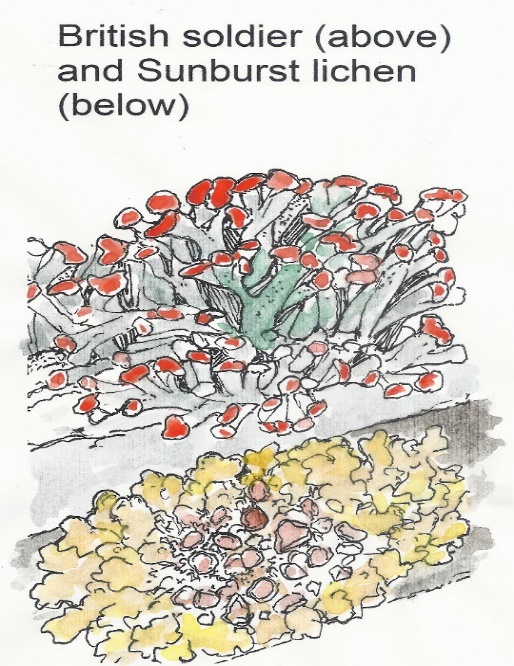
One important application of lichen biology is in monitoring environmental conditions, and especially air pollution. Measurable changes in lichen diversity are associated with increasing levels of contaminants in air. The steady improvement of air quality in our major cities over recent decades has been demonstrated by the restoration of earlier levels of lichen diversity in places like New York City. But some increases in lichen diversity are not good news as they signal invasive species continuing to advance into new habitats. Such is the case of the maritime sunburst lichen (Xanthoria parietina). This colorful, bright-yellow species was originally confined to shoreline vicinities frequented by nesting seabirds. Abundant bird guano filled the surrounding air with an enrichment of nutrients.
In my experience as an Alaskan wilderness guide, I was able to thrill bird watchers by pointing out the location of gyrfalcon nests on cliffs showing conspicuous aprons of bright orange lichen beneath rock ledges. The nitrate-contaminated air of inhabited cities has allowed nutrient-demanding lichens such as the sunburst to colonize walls and tree trunks over all of Europe and a major part of North America.
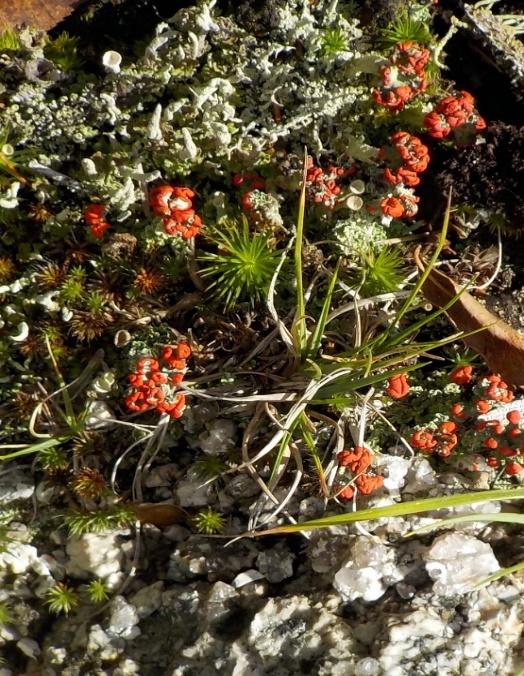
One of the most beloved lichen species native to eastern North America is the British Soldier Lichen (Cladonia Cristatella). This colorful species is a relative of the much more common reindeer “moss” that we often see as a kind of long-haired shag carpet on very dry rock outcrops. This is the ubiquitous ground covering in subarctic America and Asia that provides winter fodder for vast caribou herds. The thallus clumps of the British Soldier have the same light greenish gray seen on reindeer moss but grow a bit closer to the ground and have a brilliant red spore capsule (apothecium) on the thallus stems that recalls the color of coats worn by King George’s colonial soldiers. This is just one of the many interesting and intricately branching lichens that we see on our outings. If you look closely, you will notice that the distinctive patches of lichen on the bark of trees can dominate their visual character, and the woodland would be a lot less interesting without that addition. Think how dull the sandstone blocks lying around rock shelters and scenic ravines would be without the variously colored mottling of lichens with which they are decorated. On your next Ozark adventure take some time to appreciate the lowly lichen for the miracle of its composition and even more for its contribution to the character of the landscape.