

By Fred Paillet, OS Education Chair
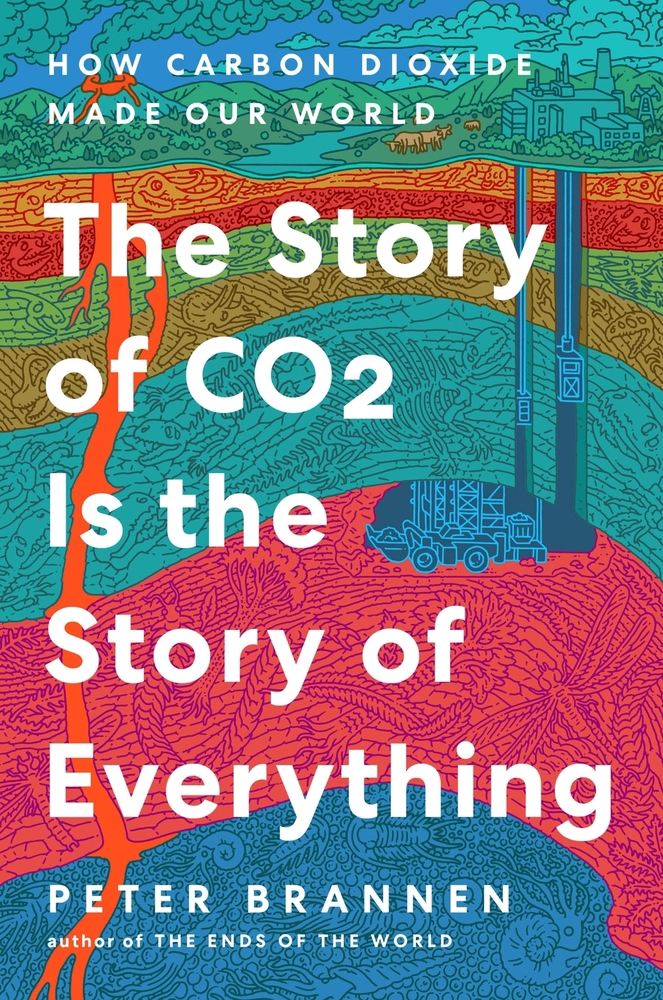 The global warming issue remains a great environmental concern, but so much has been written about the subject that only deals with a small subset of the topic. Here at last is a truly complete presentation of the carbon cycle that puts our current CO2 problem in perspective from the premise that carbon is the essential element for life on earth. In a universe trending towards heat death by increasing disorder (entropy), evolution represents the selective process of creating ordered life by redirecting the natural flow of energy to offset increases in entropy. At the very beginning, life probably originated in an early O-free environment through hydrothermal circulation in travertine pinnacles where H-rich alkaline fluids entered acidic metal-rich waters – a process called serpentinization. Natural chemical energy release created organics, then natural processes found ways to funnel energy into tighter spaces, developing enzymes to accelerate things – with the higher energy release the better the survival (that’s evolution). An initial oxidation event at 2 billion years ago came from cyanobacteria enhancing photosynthesis but then fell back in a “boring billion” until the Cambrian “explosion” of life. That created an energy capacitor where earth’s crust separated combustible carbon below from reactive oxidizer above. The energy stored in this disparity is what drives life in the face of the 2nd law of thermodynamics.
Photosynthesis acts as a unique creator of organic carbon, driven in two steps by partnering purple and green sulfur bacteria to synthesize the substance of life. Why does a later jump of O2 to 20% then coincide with appearance of multi-cell animals?
There would be little change in atmospheric O2 unless an equivalent amount of C had gone somewhere. Perhaps this ended up as the great bank of carbonate deposits that once ran diagonally across supercontinent Rhodinia from Argentina to Greenland. Maybe this had something to do with the way burrowing worm bioturbation of the seabed fundamentally changed carbon storage there. Regardless, something important in carbon cycling occurred about 580 million years ago as indicated by a spike in light carbon isotopes (the Shuram event). After the Cambrian “explosion” in diversity, the steady plateau of O2 needed more carbonate sedimentation (sequestration) to offset O2 sinks of mineral oxidation and volcanic CO2 additions, with shifts in atmospheric oxygen and carbon storage related to first the effect of plant roots on rock weathering, and then the great storage of carbon in coal that followed. Several extinction events resulted from CO2 spikes from continental rifting (basalt outpouring) and polar glacier ice sheet development, with the most severe at 260 million years ago (end Permian). The latter event included accelerated erosion in an extreme hothouse atmosphere, oxygen starvation in putrid sediments, and anaerobic poisoning with massive H2S emission. At that time Siberian rifting had caused volcanic eruptions to set fire to vast fossil fuel deposits that dwarf our modern use of petroleum and coal. No reassurance there, because our rate of release is a thousand-fold greater than the rate then which was spread over hundreds of thousands of years. Some idea of the long-term resilience of the carbon cycle is given by the relatively modest carbon excursions after the Chesapeake Bay impact crater (36 million years ago) and the Columbia Basin basalt flood (16 million years ago). Overall, there’s a long slow downward trend in CO2 and temperature after the dinosaur killing impact event (65 million years ago), from >1000 ppm Eocene spike (55 million years ago) to 400 ppm in Pliocene (3 million years ago) with 3-4° C warmer and sea-level 70 ft higher.
We can track the correlation of CO2 and sea-level thanks to Exxon’s elaborate sea-level plots created as a byproduct of seismic sediment layer analysis in petroleum reservoir exploration. There’s still the Pliocene mystery as to why it was so relatively hot and humid with higher sea-level and yet the same 400 ppm CO2 as today, highlighting how little we know about short-term versus long-term change in the carbon cycle. We can find little reassurance in the long-term stability of life in general if there’s a short-term extinction of mankind. Over almost all of earth’s history life existed with photosynthesis as the sole energy source while slowly evolving ever better channels to focus that energy as a ratchet of increasing order in the face of the natural drain of energy to increasing entropy. Humans ultimately made the great leap by adopting fire, providing a new jolt to brain capacity in metabolization of nutrients. This lighted a long “fuse” of development as “mental buffering” focused the capacity for extracting energy from resources through social structure leading from tribal bands to organized nations.
The author maintains that human consumption now devours one third of all photosynthetic energy production with the help of fossil fuels providing so much fertilizer and mechanized cultivation.
The fundamental theme here is that energy flow allows life to find ever evolving ways to funnel energy into structures that allow ever higher levels of order to offset increased disorder elsewhere. Comparisons with CO2 excursions in the past remain difficult because humans can never produce the net total change in CO2 emission volume that triggered past extinction events, but additions are now being released at a thousand-fold greater rate. This is so far from any such rate occurring in the past and the short-term variables within carbon cycle function so uncertain that we are taking the very basis of life into completely unknown territory. Modern fossil fuel consumption is thus an inverse of the Cambrian explosion of life – back then the sudden increase in atmospheric O2 lead to a sudden diversity of life; now a reversal by reuniting the below ground carbon with airborne O2 for perhaps an equally dramatic (but as yet undetermined) effect.
There’s no doubt that the intensity of human wellbeing has been enhanced by fossil energy consumption. But expect continued growth by progress against entropy at the cost of even more energy use to provide information and computation needs in the coming AI age. Our present climate change crisis is made so critical because CO2 is the story of everything – our energy use is deeply entangled with the very basis of life. In the past economic growth was tied to increase energy use, but increases in use efficiency failed to prevent increasing energy demand. For example: since 1975 the US doubled energy use efficiency but consumption went up by 20%. We must get off fossil fuel as soon as possible, but experience shows we will still need more energy to do so – especially in the mining of conductive copper and rare earth minerals needed to equip the transition to clean energy. Then the huge energy costs of mitigation programs such as crushing basalt or scrubbing CO2 from the air. But degrowth must be a deeply traumatic experience. Think of progressive but elite scientist Lavoisier and the way the starving Paris mob dealt with his progressive ideas in the face of dire economic stress. Survival will be like threading a needle to keep human passions at bay while restricting fossil energy use. If recent experience is an example, decrease in energy use has only been achieved by economic collapse. The free market economy of unrestricted capitalism that has propelled us to this carbon emission condition can’t lead to a solution since it never looks beyond the immediate time frame. The author ends up hoping that the human mind’s evolved ability to cope with the world around it will find a way out of this crisis but provides the reader with scant evidence that this is going to happen. We are left with the vision of humanity taking earth’s climate to some place it has never been while we have no firm understanding of the dynamics of the process or the effect on life that it will have. Maybe our carbon-based future is even scarier than we thought.